

B2B logistics and wholesale fulfillment: what it is, who it's for, and how it works
Large orders, many units, delivered to other businesses — from distributors to brands feeding eMAG and Trendyol. Here's what B2B fulfillment means, who it suits, and why a single stock for both B2B and B2C simplifies your entire operation.
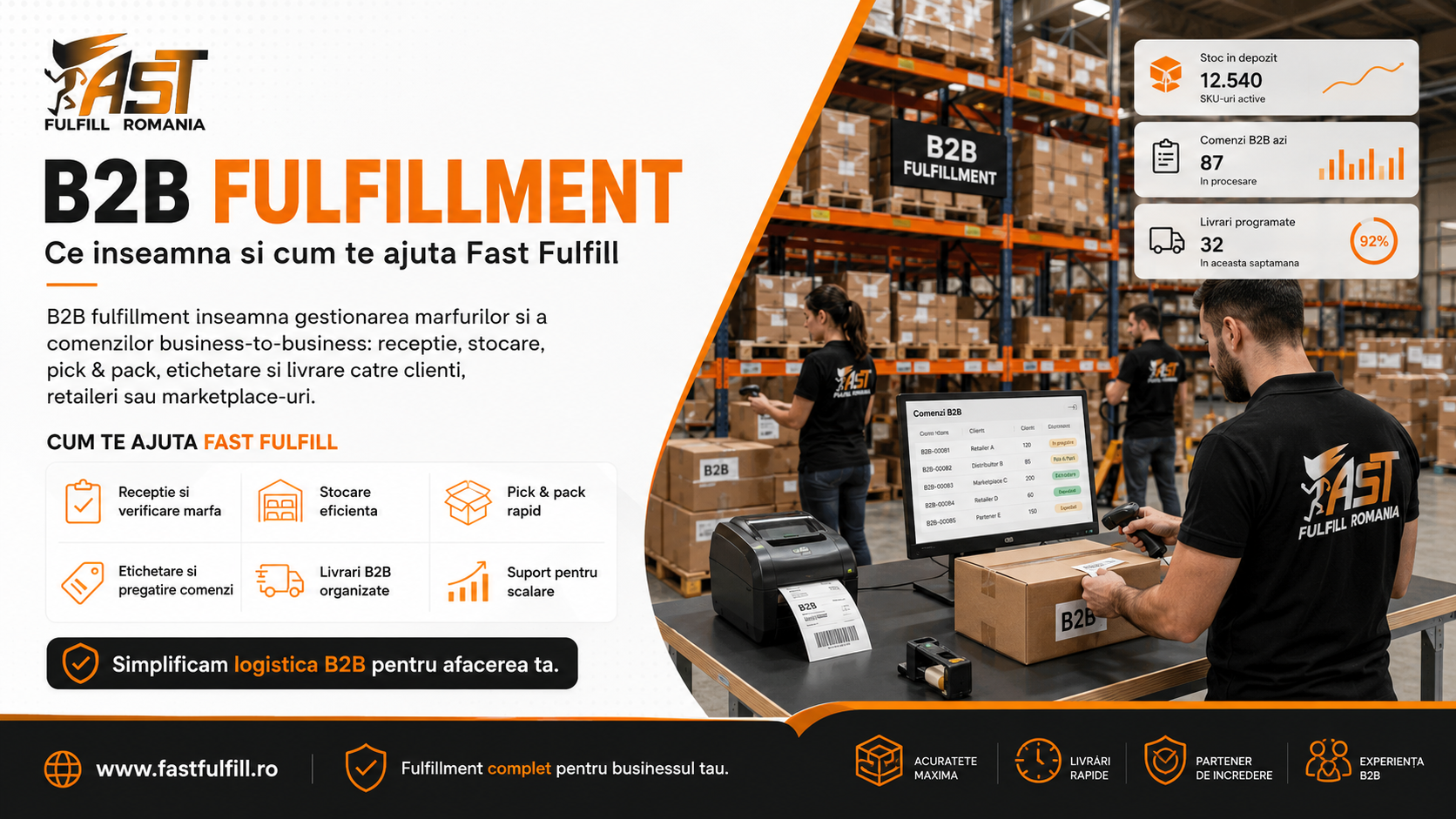
B2B fulfillment means large orders, with many units per order, to other businesses. At Fast Fulfill, the same goods feed both wholesale deliveries (distributors, retailers, FBE) and individual parcels to consumers — from a single warehouse, with one receiving process and one invoice. Plus kitting, co-packing and transparent tier pricing.
When people think of fulfillment, most picture small parcels sent to an end customer — that is, B2C (business-to-consumer). But a huge share of commerce is B2B (business-to-business): you deliver large quantities to other commercial partners — a distributor, a store chain, a marketplace you feed in bulk. B2B logistics has its own rules, volumes and flows, and managing it in-house quickly becomes a drain on space, time and capital. Let's see exactly what it involves and who it suits.
The definition
What B2B fulfillment is and how it differs from B2C
The fundamental difference between B2B and B2C isn't the product type, but the volume per order and the recipient:
At Fast Fulfill, the B2B flow includes receiving goods (including 40ft containers and pre-palletized pallets), storage on shelf or pallet, preparing large orders (volume picking, kitting, co-packing), packaging for wholesale transport, and handover to the courier or carrier. If you want to understand how a fulfillment center works in detail, we wrote a complete separate guide.
The target audience
Who outsourced B2B logistics suits
Distributors and wholesalers
You deliver goods to physical stores, chains or other retailers. You need pallet storage, volume picking and large order preparation — without managing your own warehouse and team.
Brands feeding marketplaces
You ship goods in bulk to Fulfillment by eMAG (FBE), eMAG retail or Trendyol. We prepare and dispatch the replenishment batches, while the rest of the stock stays available for your other channels.
Manufacturers
You produce but don't want to handle storage and wholesale delivery. You outsource all logistics — from receiving production to delivering to your commercial clients — and focus on what you do best.
Online stores with wholesale
You do B2C, but you also have clients buying in large quantities (resellers, corporate, company gifts). You process both order types from the same stock, with no separate systems.
Advantage #1
A single stock for B2B and B2C — no fragmentation
This is, by far, the most important advantage of an operator that does both types of fulfillment. Many businesses end up keeping separate stocks: one part for individual online orders, another for wholesale deliveries. The result? Capital locked in two places, the risk of running out on one channel while you have surplus on another, and double management effort.
With Fast Fulfill, the same physical goods feed both flows. The same product pallet can serve 200 individual B2C orders from Shopify today and a 500-unit B2B delivery to a distributor or to FBE tomorrow. One inventory, one receiving process, one monthly invoice. Your stock "breathes" freely between channels, instead of sitting buried in separate pockets.
For a business that sells both individually online and wholesale, stock fragmentation is one of the most costly hidden inefficiencies. A single stock for all channels means freed-up capital, zero cross-channel stockout risk, and a clear, real-time picture of your entire inventory.
Advantage #2
Kitting, co-packing and wholesale order preparation
B2B logistics isn't just "pick from the shelf and ship". Often, wholesale orders need special preparation before delivery. Fast Fulfill offers:
- Kitting — assembling several different products into a single set (for example, a promotional bundle of 3 different SKUs, or a corporate gift set).
- Co-packing — grouping and repackaging products into cases or delivery units, according to your commercial client's or the marketplace's requirements.
- Pallet preparation — organizing goods on pallets for delivery to retailers or to feed marketplace warehouses.
- Labeling — applying barcodes, shipping labels or specific labels required by the recipient.
These services are quoted at an hourly rate (14 €/hour) or per project, depending on complexity. The exact way of working is established at onboarding, when we understand your concrete flow.
Advantage #3
Transparent tier pricing — no minimum volume or fee
In B2B, cost is calculated based on total units shipped, not just the number of orders. The tier formula is simple: orders × units per order = total units/month. The larger the total volume, the lower the cost per unit.
Here's a concrete example for a distributor:
A distributor with 100 orders/month does NOT fall into T2 (as the order count alone would suggest), but into T6 — because the actual shipped volume is 2,000 units. That means much lower per-unit rates than it appears at first glance. B2B logic rewards volume.
Beyond picking and receiving, you have storage at 0.40 €/m³/day (on shelf or pallet), receiving a 40ft container at 180 €, and kitting services by the hour. The full grid is public on the pricing page, with no hidden negotiations. And, as everywhere at Fast Fulfill: no guaranteed minimum volume, no minimum monthly fee. You can calculate your own cost in our interactive calculator.
Advantage #4
Fast 48h onboarding and ERP integrations
From signing the contract to the first shipped order takes 48 hours. We integrate natively with e-commerce platforms (Shopify, WooCommerce, eMAG, MerchantPro, Trendyol and others) and with ERP and invoicing systems (SmartBill, NexusERP, SoftOneERP), so that B2B and B2C orders flow automatically into our system and stock syncs in real time. For more complex B2B flows or custom integrations, we settle the technical details at onboarding.
Need B2B logistics for your business?
Tell us your volume (orders, units, goods type) and we'll build a concrete cost calculation, plus a discussion about your specific delivery flow. No minimum volume, no obligations.
Frequently asked questions
FAQ — B2B logistics and fulfillment
What is B2B fulfillment?
B2B (business-to-business) fulfillment is the service where an operator stores your goods and prepares large orders, with many units per order, for other businesses — distributors, retailers, physical stores, marketplaces. Unlike B2C (individual orders of 1-3 products to a consumer), a B2B order can have dozens or hundreds of units, delivered on pallets or in bulk. Fast Fulfill processes both types from the same stock.
Who is outsourced B2B logistics for?
It's for: distributors and wholesalers delivering to physical stores; brands feeding marketplaces in bulk (FBE, eMAG retail, Trendyol); manufacturers wanting to outsource storage and wholesale delivery; and large online stores that also sell wholesale alongside B2C. In short, any business shipping large volumes of units to commercial partners.
How is B2B fulfillment cost calculated?
B2B cost is calculated based on total units shipped: orders × units per order = total units/month. For example, 100 orders × 20 units = 2,000 units → tier T6. The larger the total volume, the lower the cost per unit. Storage is 0.40 €/m³/day, receiving a 40ft container is 180 €. No minimum volume or minimum monthly fee.
What is the difference between shelf and pallet storage?
SHELF — for individual products, per-unit picking (typical B2C and B2B with small units). PALLET — for large volumes, palletized goods (typical B2B distribution and marketplace replenishment). Both are charged by occupied volume (0.40 €/m³/day). The exact setup is established at onboarding, based on goods type and delivery flow.
Can I do B2B and B2C from the same stock?
Yes — it's one of the biggest advantages. The same physical goods feed both B2C orders (individual parcels from Shopify, eMAG, own website) and B2B orders (wholesale deliveries to distributors or to feed FBE). One inventory, one receiving process, one invoice. You eliminate capital locked in parallel stocks and the risk of cross-channel stockouts.
Do you offer kitting and co-packing for B2B orders?
Yes. We offer kitting (assembling several products into a set), co-packing (grouping and repackaging into cases or delivery units) and pallet preparation. These services are quoted at an hourly rate (14 €/hour) or per project, depending on complexity. Send the operation description and estimated volume for a concrete quote.