

How a Fulfillment Centre Works — Complete Guide on Process, Benefits and Costs
From the moment your stock arrives at the warehouse to the AWB handed to the courier. The end-to-end process, industry standards backed by international sources, and what you would need to build yourself to meet that standard in your own warehouse.
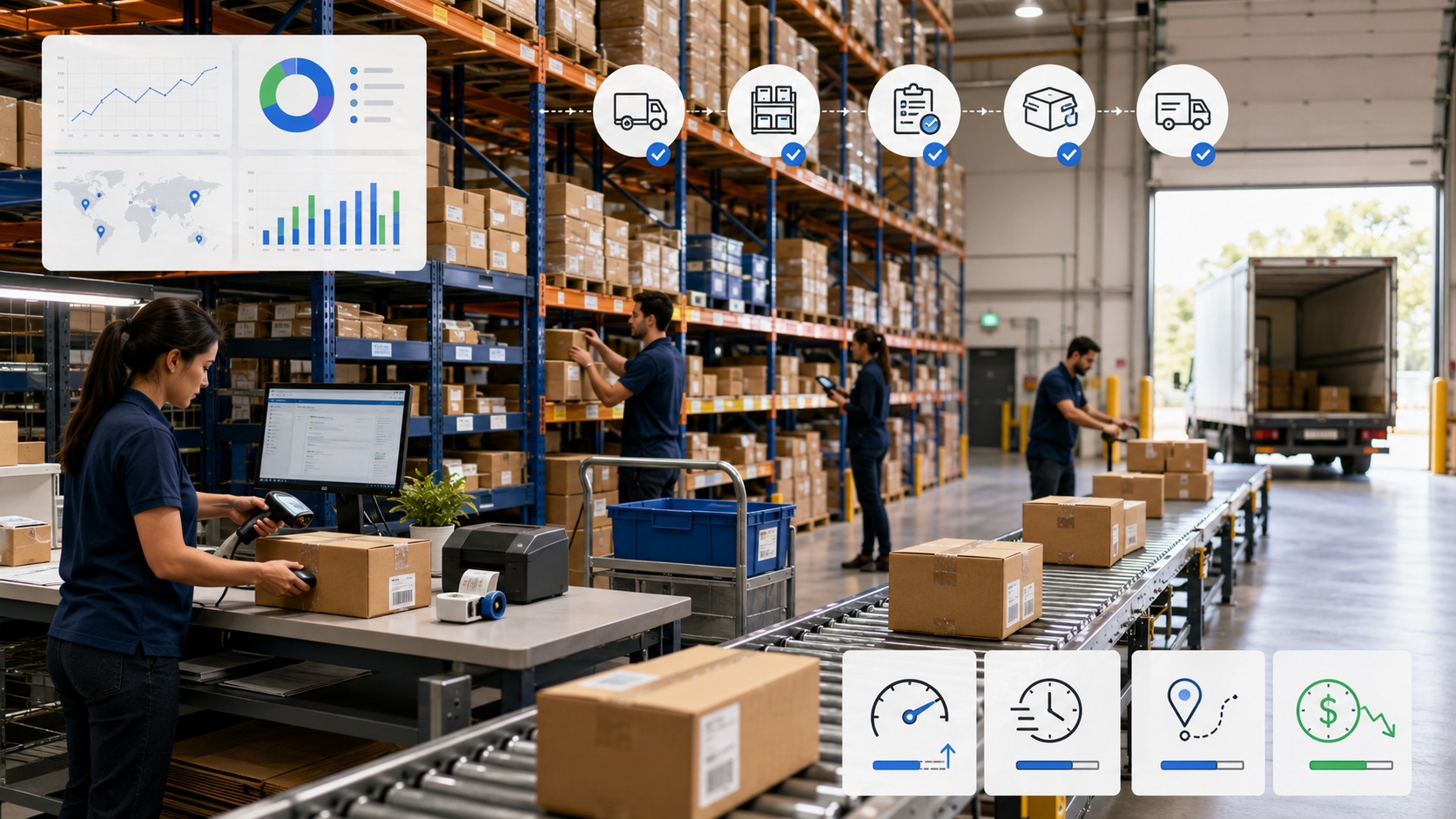
If you run a growing online store, you have come across the term "fulfillment" in dozens of places — on LinkedIn, in eCommerce articles, in recommendations from other entrepreneurs. But very few people actually explain what happens inside a fulfillment centre, step by step, from the moment they receive your stock to the moment a customer opens their parcel.
This article shows you the entire process — no jargon, no marketing. For each stage you will see the industry standard (with operational figures from international literature) and what you would need to build yourself to reach that standard in your own warehouse — in terms of equipment, complexity, and required expertise. At the end you will have the complete picture: what real benefits outsourcing brings for an online store that is growing.
Important to understand from the start: not all fulfillment centres are equal. There are serious fulfillment operations with modern WMS, real-time scanning, and consistently respected SLAs — and there are poorly managed ones that create exactly the problems you were trying to avoid (delayed orders, lost stock, hidden fees, inconsistent packing). Throughout this article you will see the concrete differences, because choosing the wrong fulfillment partner can damage your business just as much as chaotic in-house operations.
What is a fulfillment centre?
A fulfillment centre is a specialised warehouse that takes over the entire logistics operations of an online store: it receives stock, stores it under professional conditions, automatically receives orders from the online store's platform (Shopify, WooCommerce, eMAG, MerchantPro, etc.), picks them, packs the parcel, hands it to the courier, and manages returns.
Instead of having your own warehouse, your own picking team, your own WMS, and your own courier contracts, you pay a cost per order that includes all of these. The entrepreneur focuses on sales and growth; the fulfillment partner handles everything else.
The end-to-end process
The 6 stages of a complete fulfillment flow
Here is exactly what happens to an online store's stock from the moment it leaves the supplier (or manufacturer) to delivery to the end customer. Each stage has a clear purpose, specific equipment, and an operational standard documented in international literature.
Stock Receiving
Goods enter the warehouseThe process begins when the delivery truck (from the supplier or the store) arrives at the warehouse. Receiving is scheduled 24–48 hours in advance so the team and space are ready. For 40ft containers or pallet deliveries, scheduling happens 3–5 days ahead — because the unloading workflow is different.
At the moment of unloading, every unit received goes through a standardised validation process. Nothing enters active stock until it has been physically checked and digitally recorded. This is the point where errors cost the least to correct — any mistake here propagates through the entire rest of the flow.
- Unloading with a pallet truck (or appropriate equipment for a 40ft container)
- Quantity check against the supplier's delivery note / invoice (ASN)
- Visual inspection — damaged products are photographed and reported
- Barcode scanning with an industrial scanner (WMS validation)
- Internal label applied if the product has no barcode of its own
- Dimensions (L × W × H) and weight measured per unit
- Recorded in WMS with an allocated shelf location
- Receiving report automatically sent to the merchant
Inventory accuracy begins at receiving — the industry benchmark is 99.5%, while best-in-class reaches 99% or more per Logimax WMS and NetSuite.
Documented cases (Allied Hygiene) show a jump from 75% to 99.6% after implementing WMS + scanning at receiving per RF-SMART/NetSuite. Dock-to-stock cycle time (the time from truck arrival to stock available for picking) is a key KPI — receiving with automatic scanning reduces it significantly.
- Professional WMS with scanning at receiving that supports ASN, automatic validation, and location assignment
- Industrial scanners (Zebra, Honeywell) — minimum 2–3 devices for the receiving area
- Label printers + metrologically verified scales for products without barcodes
- Electric pallet truck or forklift suited to the type of goods received
- Staff trained on rigorous receiving procedures — minimum 4–6 weeks of onboarding
- Dedicated receiving zone layout, separate from storage, with a loading dock
- Operational discipline: nothing enters stock without physical + digital validation
Storage
Every SKU gets a homeAfter receiving, each SKU is placed in an individually mapped physical location in the WMS — not in a communal pile. This is the major difference between a professional warehouse and a room with shelves: every product has exact coordinates (shelf 12, level 3, location 7B), and the system knows at any moment how many units are there.
Individual location per SKU enables fast picking (the operator doesn't search — the system tells them where to go) and continuous cycle counts (the system automatically detects any difference between the expected and actual quantity).
Stock organisation follows two standard operational principles: FIFO (First In, First Out) for general products, and FEFO (First Expired, First Out) for products with an expiry date (cosmetics, supplements, food). This ensures stock does not age and no expired products are sent to customers.
- High-turnover SKUs are placed in accessible zones (near the packing station)
- Seasonal or slow-moving SKUs in secondary zones
- Fragile or special-requirement products have dedicated locations
- Stock with expiry dates is organised by FEFO
- Remaining stock is organised by FIFO for consistent rotation
- Periodic internal cycle counts included in the cost
Inventory accuracy benchmark = 99.5%, best-in-class 99%+ per NetSuite. Top performers with RFID + modern WMS reach 99.99% per OptimoRoute.
According to Interlake Mecalux, the global WMS market is growing at 15.3% annually through 2028. 93% of modern warehouses already use a WMS, according to Logistics Management data cited by RF-SMART.
Without a WMS, real accuracy in manually operated warehouses drops to 75–85% — exactly the Allied Hygiene case before implementation.
- Dedicated professional space: minimum 200–400 sqm for a store with 1,000–10,000 orders/month
- Industrial racking with clearly mapped locations (shelf labels + WMS)
- WMS with location management — hot/cold zones, putaway logic, automatic FIFO/FEFO
- Cycle counting system (automatic continuous stock counts) integrated in WMS
- Permanent supervisory staff to maintain operational discipline day by day
- Stored goods insurance calibrated to the actual value of inventory
- Re-layout at every major change in SKU mix or seasonality
Picking
From order to product in handThis is where automation works its magic. When a customer places an order on the online store (Shopify, WooCommerce, eMAG, MerchantPro, etc.), the native WMS integration syncs the order automatically within seconds. The picking operator receives directly on their scanner the instruction: which SKU, in what quantity, from which location.
The operator uses a cart with compartments (for simultaneous picking of multiple orders, known as "batch picking") or a tray (for individual picking), follows WMS-optimised routes, and scans each product picked to confirm it is the correct one. The double scan virtually eliminates human error: if the operator scans the wrong product, the system alerts them immediately before they continue.
The picking route is not random — the WMS algorithm calculates the shortest path through the warehouse to minimise travel time.
- Order enters the WMS via direct API integration with the store's platform
- WMS optimises the operator's route to minimise travel time
- Operator scans the barcode of each product picked (double validation)
- For multi-item orders, the system confirms each unit
- The picking trolley is taken to the packing station
According to Optioryx 2026, an average picker with modern systems (WMS + scanner) achieves ~71 picks/hour. Top performers, with pick-to-light and pulse-picking optimisation, reach 120+ picks/hour.
Per PulpoWMS, a modern WMS "doubles picking speed" compared to manual methods. Per Pallite Group, in poorly organised warehouses non-productive time represents 40–60% of the picker's time — exactly what WMS eliminates through optimised routes.
Picking accuracy benchmark is below 0.5% error rate. The Allied Hygiene case: jump from 75% to 99.6% accuracy after WMS + scanning per RF-SMART.
- WMS with pick path optimisation and real-time scanning (the same system as at receiving)
- Wearable or handheld industrial scanners for each active picker
- Ergonomic picking trolleys with compartments for batch picking
- Trained pickers — minimum 2 pickers for a mid-volume store, with a 4–6 week learning curve for a new picker to reach 30+ picks/hour
- Optimised layout (hot/cold zones, minimised distances) — re-arranged at every major change in SKU mix
- Experienced supervisor to manage the order queue and balance team workload
- Scaling capacity: how do you handle 10× the volume on Black Friday without chaotic last-minute hiring?
Packing
The parcel is ready for the roadAt the packing station, the picked products are visually checked one last time, then packed according to the store's preferences: standard envelope, bubble-lined envelope, small box, standard box, or no additional packaging (when the product has its own retail box). Packaging material is included in the cost per order.
The packing station is ergonomically configured: table at the right height, tape dispenser, thermal AWB printer, commercial scale to verify weight before handover to the courier. The operator applies the AWB, seals the parcel, and places it in the pre-dispatch area, sorted by courier.
- Final visual check of products
- Selecting the appropriate packaging according to the store's settings
- Adding protective materials (bubble wrap, paper, promotional inserts)
- Sealing with brand-neutral or customised tape (on request)
- Printing and applying the thermal AWB
- Final weight check on scale
- Placing in the pre-dispatch area, sorted by courier
Purchasing packaging materials in large volumes (wholesale) reduces cost per unit by up to 30% per Alexander Jarvis. Automatic right-sizing of boxes (dynamic selection of the right size) saves a further 15–25% per the same study.
According to Opensend 2025, consistent packaging has a direct impact on customer satisfaction: 52% of online shoppers consider the unboxing experience important to their overall satisfaction. Branded packaging increases brand recall by up to 30%.
- Ergonomic packing stations — tables at the right height, dispensers, adequate lighting, ergonomic seating
- Thermal AWB printers — one per packing station
- Metrologically verified commercial scales to check weight before the courier
- Bulk purchasing of materials — access to wholesale prices requires ordering full pallets, with corresponding storage space
- Storage space for packaging materials — separate from the product storage zone
- Dedicated staff for medium-to-large volumes, trained on packing consistency
- Standardised processes: the same parcel must look identical the 100th time as the first time
Dispatch
Handover to courier — same dayThis is where the cut-off comes into play — the moment when courier collection takes place. The industry standard for modern fulfillment centres is a cut-off at 15:00 on working days: orders received and validated before this time are fully processed (picking, packing, AWB, courier handover) on the same day. Orders received after the cut-off ship on the next working day.
Parcels are sorted by courier and physically handed over to the couriers who come to collect them. The store holds the direct contract with the courier (Sameday, FAN, DPD, GLS, Cargus) — the fulfillment centre integrates their AWBs into the WMS and hands over the parcels. The courier cost is a pure pass-through — exactly the courier's rate, with no margin added on top.
For Bucharest and Ilfov there is also a dedicated Same-Day delivery option (delivery to the end customer on the same day), after activation on the courier account. For international deliveries (EU and non-EU), fulfillment centres with cross-border experience integrate international couriers (DHL, UPS, TNT).
- Sorting parcels by courier (Sameday, FAN, DPD, GLS, Cargus, international)
- Physical handover to the courier at their daily collection time
- Handover confirmation in WMS — AWB becomes active on the courier's system
- Automatic dispatch of tracking notification to the end customer
- Same-Day delivery option available for Bucharest/Ilfov (after activation)
The standard cut-off for same-day courier handover is between 14:00 and 16:00 in the global 3PL industry. Modern fulfillment centres achieve a same-day fulfillment rate of 95%+ for orders received before the cut-off.
Negotiating preferential courier rates requires aggregated volumes of at least 5,000–10,000 parcels/month. Below these thresholds, individual stores receive retail rates. 3PL operators with aggregated volumes across hundreds of clients obtain discounts of 20–40% which they can pass on.
- Direct contracts with major couriers (Sameday, FAN, DPD, GLS, Cargus) — minimum 3–4 contracts to offer options to the end customer
- API integrations with each courier for automatic AWBs, without manual data entry
- Negotiating preferential rates — difficult to achieve below significant aggregated volumes; individual stores receive retail rates
- Pre-dispatch space sorted by courier, separate from the packing zone
- Processes for failed deliveries — sorting, evaluation, restocking or re-attempt
- Cut-off discipline: the capacity to process all orders received before the deadline, regardless of volume
Returns
When the parcel comes backReturns are an integral part of eCommerce — approximately 5–15% of B2C orders come back, depending on product category (fashion reaches 20–30%, beauty/electronics less). The returns process is the mirror of the outbound process, but with additional evaluation steps.
The return parcel arrives at the warehouse (from the courier or directly from the end customer), is opened, the product is visually inspected and evaluated — good condition, damaged, or non-conforming — then restocked if in good condition, or processed according to the store's instructions (transferred to the "defective" zone, returned to supplier, written off).
All information appears instantly in the client portal. For claims or evidence, photo documentation can be provided on request. Fast restocking is important: a returned product sitting for 2 weeks in the returns zone is blocked capital.
- Receiving the return parcel (from courier or directly)
- Opening and visual inspection
- Condition evaluation: fit for restocking, damaged, or non-conforming
- Photo documentation on request (for claims or evidence)
- Restocking (if in good condition) with location allocation and WMS update
- Processing according to store instructions for non-conforming products
- Automatic notification in client portal with full details
Average eCommerce return rate: 10–15% generically, up to 20–30% in fashion, below 5% in categories such as sealed beauty products or electronics.
Industry standard for processing a return: 24–72 hours from receipt to restocking. Under 24 hours is best-in-class. Over 72 hours is considered inefficient — capital remains blocked in products that could be sold.
- Dedicated returns zone, separate from the outbound zone
- Staff for returns evaluation — for a mid-volume store with a 10% return rate, this is a significant workload
- Written evaluation procedures: what is fit for restocking, what is "defective", what gets written off — and systematic photo documentation for each case
- Returns flow in WMS: restocking with location validation, automatic stock update
- Zone for defective products pending final decision (return to supplier, write-off, etc.)
- Processing time discipline: 24–72h max, otherwise your capital remains blocked
The technology behind it
What makes the flow work without manual intervention
All 6 stages above function smoothly because behind them there is a technology layer that orchestrates everything. Without it, you have a warehouse. With it, you have a fulfillment centre.
The technology stack
A serious fulfillment centre in 2026 operates on the basis of these 4 integrated systems. The absence of any one of them means invisible but real operational problems: stock errors, lost orders, unexplained delays, lack of visibility for the store's client.
WMS (Warehouse Management System)
The brain of the warehouse. Knows at any moment which SKU is where and in what quantity, optimises picking routes, validates scans, manages inventory. The global WMS market is growing at 15.3% annually through 2028 — a sign that adoption continues to accelerate.
Native integrations with major platforms
Bidirectional API with Shopify, WooCommerce, eMAG, MerchantPro, NopCommerce, Trendyol, Temu, FGO, and ERPs (SmartBill, NexusERP, SoftOneERP). Orders come into the WMS automatically; stock updates back to the platform automatically — no manual export/import.
Client portal 24/7
The control interface for the store: current stock, orders in progress, dispatched orders with AWB, receivings, returns, detailed monthly invoices. See everything in real time, anywhere, anytime.
Field equipment
Industrial scanners (Zebra, Honeywell), thermal AWB printers, metrologically verified scales, mobile terminals for operators. Technology that reduces human error to below 0.5% per operation.
Benefits of outsourcing
Why well-executed outsourcing fundamentally changes your business
Having seen the flow of each stage and what you would need to build yourself to reach the industry standard, the benefits of outsourcing to a serious partner become evident. Keep the nuance in mind: outsourcing to a poorly managed fulfillment can be more costly than in-house operations. The benefits below only materialise if you choose a partner who genuinely meets industry standards.
Time recovered — 10–20 hours/week
You are no longer the entrepreneur packing parcels in the evening, hiring pickers for Black Friday, managing courier complaints. At Fast Fulfill you have zero operational involvement — all those hours can be redirected to strategy, marketing, and product development.
Scalability without investment
You can grow from 500 to 5,000 or 50,000 orders/month without hiring a single person or buying additional racking. Black Friday becomes a normal day, not an operational crisis with temporary hires and emergency equipment.
Storage charged on real measured volume
At Fast Fulfill we use the same model as large international warehouses (Amazon, ShipBob): we measure every product at receiving and charge only the real space occupied. Sell your stock → volume decreases → you pay less, automatically. You never pay for empty space.
Pass-through courier rates
Courier rates 20–40% better than you would obtain individually, negotiated on aggregated volumes. And at Fast Fulfill we invoice you exactly the courier's rate, with no hidden margin — a rarity on the market. That alone can justify outsourcing.
Industry standard from day one
Modern WMS, native integrations with all major platforms, industrial scanners and printers, picking accuracy above 99.5% — all operational from day one. You access in 48 hours infrastructure that would otherwise take months to build.
Reduced operational risk
Picking mistakes, low stock accuracy, cut-off delays, returns left for weeks — all risks covered by your partner, you no longer carry these risks in your own operational flow. At Fast Fulfill we have an SLA written into the contract.
Same-day SLA with 15:00 cut-off
Orders received by 15:00 are handed to the courier on the same day, guaranteed in the SLA. At a store handling its own logistics, same-day depends on congestion and availability. At a poorly managed fulfillment, the cut-off "slips" in peak season. At Fast Fulfill — 15:00 is respected consistently.
International presence
Fast Fulfill has a combined presence in Romania and the United Kingdom, with integrations for international couriers (DHL, UPS, TNT) and clear processes for cross-border deliveries. For stores looking to grow in the EU or UK, the advantage is direct.
The real costs
How much you actually pay for all of this
The question you inevitably ask: how much does it actually cost? The short answer is that it depends on monthly volume, product dimensions, and the type of packaging chosen — but with two concrete anchors you can keep in mind.
The pricing model of a serious fulfillment centre is built on volume tiers — the more volume you have, the lower the price per order automatically. At Fast Fulfill there are 8 public pricing tiers, with no negotiation — rates apply automatically according to the published grid. And at the end of the month, your invoice shows exactly what you consumed, broken down by category: receiving, storage, picking, packing, returns.
Important to know:
Modern, transparent fulfillment centres have no guaranteed minimum volume and no minimum monthly fee. You can start with 50 orders/month and grow naturally over time. You pay exactly for what you use.
Frequently asked questions
What is a fulfillment centre?
A fulfillment centre is a specialised warehouse that takes over the entire logistics operations of an online store: it receives stock, stores it under professional conditions, automatically receives orders from the store's platform (Shopify, WooCommerce, eMAG, etc.), picks them, packs them, hands the parcel to the courier, and manages returns. In essence, it replaces the need for your own warehouse, your own picking team, your own WMS, and your own courier contracts.
What is the complete flow inside a fulfillment centre?
The standard flow has 6 stages: (1) Stock receiving — unloading, verification, barcode scanning, WMS location assignment; (2) Storage — each SKU on an individually mapped location, organised by FIFO or FEFO; (3) Picking — the order enters the WMS automatically from the platform via native integration, the operator picks products with an industrial scanner; (4) Packing — packaging with appropriate materials, sealing, AWB application; (5) Dispatch — handover of the parcel to the courier before the cut-off (standard 15:00 for same-day); (6) Returns — receiving, inspection, evaluation, restocking.
How much does a fulfillment centre cost?
Prices can start from €0.61/order for pick & pack in a courier envelope (with packaging and labour included). For a typical store with small products, all-in with receiving, storage, and courier handover, the total cost lands around €0.80/order. The actual cost depends on monthly volume (8 pricing tiers with decreasing prices), the type of packaging chosen, and product dimensions and weight. The public calculator at fastfulfill.ro/preturi gives you an instant estimate.
What is the industry standard for picking accuracy and productivity?
According to Optioryx 2026, an average picker with modern systems (WMS + scanner) achieves ~71 picks/hour. Top performers, with pick-to-light and optimisation, reach 120+ picks/hour. Inventory accuracy benchmark is 99.5% per NetSuite and Logimax, while best-in-class reaches 99% or more. Documented cases (Allied Hygiene) show a jump from 75% to 99.6% after WMS + scanning implementation.
What is the cut-off time for same-day delivery at a fulfillment centre?
The industry standard is between 14:00 and 16:00 for same-day courier handover. The 15:00 cut-off is the reference for modern fulfillment centres — orders received and validated before this time are fully processed (picking, packing, AWB, courier handover) on the same day. After the cut-off, orders ship on the next working day. A Same-Day delivery option is also available for Bucharest and Ilfov, after activation.
Which platforms does a fulfillment centre integrate with?
A modern fulfillment centre integrates natively with the major platforms: Shopify, WooCommerce, MerchantPro, NopCommerce, eMAG, Trendyol, Temu, FGO and ERPs (SmartBill, NexusERP, SoftOneERP, MiniCRM). The integration is bidirectional and in real time — orders sync automatically into the WMS; stock updates automatically back to the store's platform. For custom platforms, a dedicated API integration can be developed.
Sources used in this article
- Picking productivity & accuracy: Optioryx — Improving Warehouse Picking Performance 2026 · PulpoWMS — Warehouse Picks per Hour · Pallite Group — KPIs for Eaches Picking
- Inventory accuracy benchmarks: NetSuite — Inventory Accuracy · Logimax — Enhancing Inventory Accuracy with WMS · Interlake Mecalux — Inventory Accuracy · OptimoRoute — Inventory Accuracy · RF-SMART — Allied Hygiene case study
- Packaging & customer experience: Opensend — Packaging Cost per Order Statistics 2025 · Alexander Jarvis — Packaging Material Cost per Order
- Related articles: How much does fulfillment cost in Romania in 2026 · Fulfillment centre vs own warehouse — the real calculation · How to choose a fulfillment centre in 2026
Why choose Fast Fulfill
We are a fulfillment centre with a combined presence in Romania and the United Kingdom, built on principles that few others on the market actually deliver: full transparency, modern technology, and genuine contractual flexibility. Here is what concretely sets us apart:
Full grid published at fastfulfill.ro/preturi with an instant calculator. No "contact us for a quote", no hidden negotiations — all 8 pricing tiers are public.
With packaging and labour included, in a courier envelope. One of the most competitive prices on the market for small products, without compromising on quality.
Orders received by 15:00 on working days are fully processed and handed to the courier on the same day. SLA written into the contract.
The courier cost is exactly the courier's rate, no mark-up. You use your own courier contract or ours with Sameday (preferential rates).
12 months with automatic renewal, unilateral termination at any time with 30 days' notice, no penalties, no minimum volume, no minimum monthly fee.
Native integration with Shopify, WooCommerce, eMAG, MerchantPro, and all other major platforms. From contract signing to first order dispatched — 48 hours.
Complete real-time visibility: stock, orders, returns, invoices broken down by category. Access anytime, without weekly email reports.
Combined RO + UK presence for cross-border, integrations with all major international couriers (DHL, UPS, TNT), clear processes for cross-border deliveries.
We are large enough to have mature technology and processes, yet focused enough that every client matters individually. Support comes directly from someone in operations, not through a ticketing system with a 48-hour response time.
See the exact calculation for your business
Public calculator for an instant estimate. Or a written quote with concrete figures within 48 hours, tailored to your actual context.