

How to Calculate the Real Cost per Order in an Online Store — Practical Guide with Full Breakdown
The 7 cost categories that always appear in a fulfillment order, the public T8 prices with a clear breakdown for each category, and the hidden cost traps that 8 in 10 entrepreneurs miss when comparing quotes for the first time.
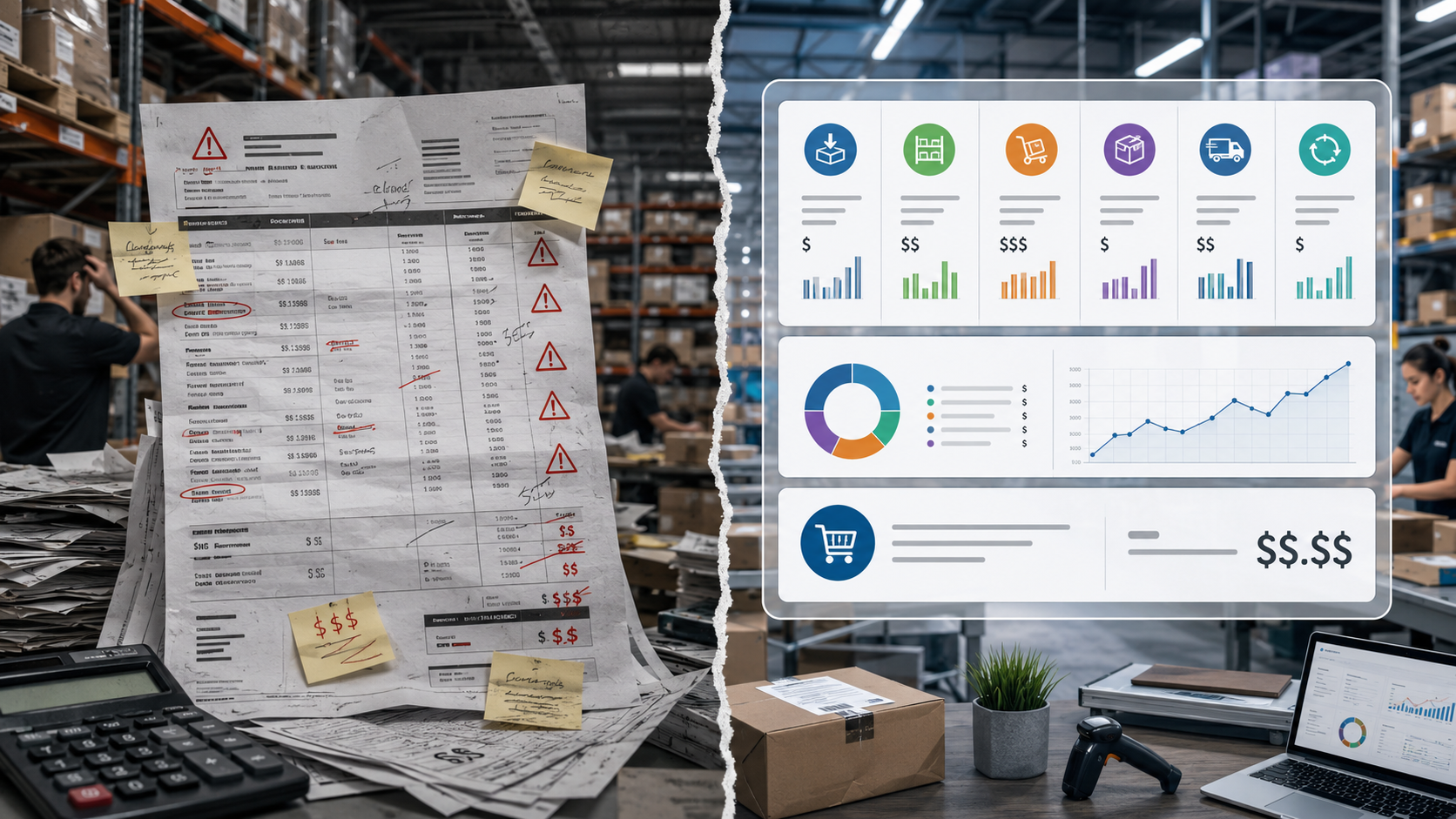
One of the most common mistakes eCommerce entrepreneurs make is comparing fulfillment quotes based solely on the pick & pack price. "Operator X is €1.20/order, operator Y is €1.80/order, therefore X is cheaper." The factual reality is more complex: the displayed price represents only a portion of the total cost — sometimes less than half of what you will actually pay. And at the end of the month, the invoice arrives at 2–3× the price shown in the quote.
This article is a practical guide that shows you how the real cost per order is truly composed: the 7 categories you must account for, a concrete scenario with full breakdown, and the hidden cost traps that typically appear on the invoice in month three. At the end you have a clear checklist to verify whether the quote you received is honest or a contractual trap.
of the real fulfillment cost is, on average, underestimated by entrepreneurs when comparing quotes between operators — because they skip the hidden cost categories: long-term storage, margin over courier, peak surcharges, minimum monthly fees. And 15–25% of the total fulfillment budget is lost to hidden fees and unforeseen operational costs that appear nowhere in the initial quote.
Source: EP Logistics — How to Calculate Fulfillment Costs 2025 · Red Stag — Hidden Fulfillment Costs.
To work with concrete figures throughout this article, each cost category has the Fast Fulfill rate clearly shown at the bottom of the section — in the form "prices start from €X". The rates shown are from the public T8 grid (the most efficient tier, for volumes above 10,000 orders/month), and for each lower tier there is an equivalent public grid. All prices are displayed transparently at fastfulfill.ro/preturi.
- Minimum Pick & Pack (T8): from €0.42/order — for a product that requires no additional packaging (just AWB applied to your retail product)
- Pick & Pack envelope (T8): from €0.61/order — for a small product in a courier envelope, with packaging included
- Minimum All-in (T8): from €0.59/order — without additional packaging, with receiving and storage included
- All-in envelope (T8): from €0.78/order — with envelope, receiving, and storage included
- Courier: direct contract between you and the courier — Fast Fulfill does not enter the transport billing flow
- Returns: from €0.46/return processed — billed only when they occur
- Public grid across 8 volume tiers — the price decreases automatically as volume grows, with no negotiation required
To make this guide actionable, each category below has the Fast Fulfill rate clearly broken down, with a worked example attached. At the end, there is a mathematical summation table showing how you get from €0.42/order (the lowest price) to €0.78/order (all-in with envelope). For any other scenario (smaller/larger volumes, different packaging type, products of different weight), the public calculator gives you an instant estimate.
The 7 categories
The components of the real cost per order — nothing hidden
Any honest fulfillment quote must break these 7 categories down clearly and separately. If the quote you received lumps them into a single "all-inclusive" price without a breakdown, that is the first sign that you cannot make a real comparison with other operators — and that the month-three invoice will contain fees you did not initially see.
Receiving cost
Per unit received at the warehouseReceiving is the first cost category, but not the first one entrepreneurs think about. It covers the physical and operational effort of moving goods from the truck into stock available for sale: unloading, quantity check against the delivery note, barcode scanning into the WMS, internal labelling if barcodes are missing, measuring dimensions and weight, and allocating a shelf location.
Standard billing models for receiving are: per unit received, per pallet, or per labour hour. According to the 2024 Warehousing & Fulfillment Costs Survey, receiving is one of the most standardised categories — but also one of the most frequently "hidden" in quotes that advertise cheap pick & pack.
- Physical unloading (pallet truck, or container 40ft equipment)
- Quantity check against delivery note / ASN
- Visual inspection — damaged products photographed and reported
- Barcode scanning into WMS
- Internal labelling if the product has no own barcode
- Dimensions and weight measured per unit
- Location assignment in WMS
- Digital receiving report automatically sent to the merchant
Base rate: €0.16/unit received
All 8 public pricing tiers at fastfulfill.ro/preturi →
Storage cost
Monthly, on volume or allocated locationStorage is the cost category with the greatest variation between operators — and where additional costs are frequently hidden. There are 3 billing models you may encounter:
a) On real occupied volume (m³ or cubic feet) — the fairest model by design. As you sell stock, the occupied volume decreases automatically and you pay proportionally less. This is the model used by large international warehouses (Amazon, ShipBob) and the one we use at Fast Fulfill.
b) On allocated shelf/location — you pay for reserved space regardless of whether it is full or half-empty. With fast turnover, you end up paying a lot for space you are not actually using.
c) Per pallet — a model for B2B or large products; you pay per occupied pallet regardless of how full it is. According to Opensend 2025, storage is typically one of the most variable categories between operators — cost differences between the 3 models can reach 50–100% for the same store.
At receiving, every product is individually measured — length × width × height — and recorded in the WMS together with the received quantity. The total occupied volume is calculated automatically based on actual dimensions.
Our rate is €0.40/m³/day — approximately €0.036/day for a volume of 0.09 m³. At monthly level (30 days), 1 m³ stored equals €12/month. As you sell stock, the occupied volume decreases — and the following month you pay less, automatically, without negotiating anything.
Why we have a minimum threshold of 0.09 m³ per active SKU: every product receives an individually mapped shelf location. This means a store with 10,000 different SKUs with a single unit each would require 10,000 separate locations — operationally inefficient for us and costly for you. The 0.09 m³/SKU threshold ensures the right balance: if your product is larger than the threshold, you pay the real volume (could be 0.2 m³, 1 m³, 5 m³); if it is smaller, you pay the reserved minimum. The model discourages excessive SKU fragmentation and keeps costs predictable for both sides.
- How is volume measured? Per product (L×W×H × quantity)? Or per allocated location?
- Is there a minimum billable threshold per SKU? How much is it and what volume does it cover?
- Are there increased rates after 30/60/90 days for unaccessed stock? (long-term storage penalties)
- Are there peak season surcharges in Q4 (October–December)?
- How is the cycle count done — included in the cost or billed separately?
Base rate: €0.40/m³/day · minimum threshold 0.09 m³/active SKU
Exact calculation on your volume: Fast Fulfill public calculator →
Picking cost
Per order, structured by complexityPicking is the physical operation by which an operator retrieves the products in an order: when a customer places an order on your online store, the WMS system directs the operator to the location in the warehouse where each product is stored, the operator follows the algorithmically optimised route, scans each product with an industrial scanner for validation, and places it in the order tray that goes on to the packing station.
Picking is the category entrepreneurs look at most closely — and on which comparisons tend to focus. But it has a more complex structure than it first appears.
The industry standard model is a base price for the first SKU + a lower price for each additional SKU + (sometimes) an even lower price for extra units of the same SKU. This reflects the real effort: finding the first product requires travelling through the warehouse (it could be at the far end), but the second SKU in the same order is more efficient (the operator is already moving, and the location may be nearby).
According to ShipBob and Red Stag, the industry standard model is structured on the real complexity of the operation — a single "flat" price per order regardless of how many products it contains would mean either over-charging on simple orders or under-charging on complex ones.
- Pick first SKU (per order): the base cost — includes locating, retrieving, and carrying to the packing station
- Pick additional distinct SKU: lower cost per each different additional product in the same order
- Pick extra unit same SKU: minimal cost per additional unit of the same product (from the same location)
- Validation by scanning: each product picked is scanned for confirmation — below 0.5% error rate with modern WMS per Optioryx
At Fast Fulfill we have a public grid across 8 volume tiers, and picking is clearly broken down into 3 components for each tier:
- First pick (first SKU in the order) — base cost per order
- Second pick (each additional distinct SKU) — lower cost, billed only if the order has more than 1 distinct product
- Extra unit (additional unit of the same SKU) — minimal cost per extra unit
Why we chose this model: we do not include 2–3 "guaranteed" units in the base price, as some operators do, because that is unfair to clients whose orders are simple (single product) — they would pay for services they do not use. With our itemised model, you pay exactly for what you actually consumed on each order. For a store where most orders are simple (1 SKU/order), this means a significantly lower picking cost than at operators with an "all-in price".
Correctly itemised structure: €0.34 first pick · €0.17 additional SKU · €0.09 extra unit
All 8 public pricing tiers: fastfulfill.ro/preturi →
Packing + materials cost
Labour + packaging materialsPacking is the operation of packaging the products picked from the warehouse ready for dispatch: the products arrive at an ergonomic packing station, the operator visually verifies them (final check), places them in the appropriate packaging (envelope, box, bubble envelope, etc.), adds protective materials if needed (bubble wrap, void fill paper), seals the parcel with tape, prints the courier AWB thermally and applies it to the parcel, checks the final weight on a scale, and sorts the parcel into the pre-dispatch area by courier.
Packing has 2 cost components: packing labour (the operator who performs the actual packaging) and packaging materials (the envelope, box, tape, bubble wrap, void fill paper).
At serious operators, packaging materials are included in the cost per order for the standard options (envelope, small box, standard box). At operators who do not include them, you will see additional charges for each box, each metre of tape, each sheet of bubble wrap — the real cost can end up 50–100% higher than the displayed price.
According to Opensend 2025, purchasing packaging materials in bulk volumes (wholesale) reduces costs by up to 30% per Alexander Jarvis — a saving that an individual store cannot access without buying full pallets of materials.
- No packaging (AWB only) — the product has its own retail box; only the AWB is applied
- Standard envelope / mailer bag — small, light, non-fragile products (clothing, accessories)
- Bubble envelope — small fragile products (jewellery, small electronics, glassware)
- Small box (~60×40×40 cm) — medium or fragile products that do not fit in an envelope
- Standard box — bulky products or gift packaging
At Fast Fulfill, the standard packaging material for each of the 5 options above is completely included in the cost per order. The envelope, box, tape, bubble wrap, void fill paper — everything is within the displayed rate, with no separate line on the invoice.
We purchase materials at wholesale prices on large volumes (full pallets of envelopes, boxes, tape) — a significant saving that an individual store cannot access. This means our packing price is competitive by design, not through hidden cuts.
For custom packaging (boxes with your logo, branded gift inserts, custom labels), the cost is quoted separately — but any of the 5 standard options comes with no invoice surprises.
All 5 standard options, materials fully included: €0.08 no packaging · €0.27 standard envelope · €0.30 bubble envelope · €0.72 small box · €1.24 standard box
All 5 packing types with public prices: fastfulfill.ro/preturi →
Courier cost
The largest component in the totalThe courier is the largest cost category in a fulfillment order — and paradoxically, the one entrepreneurs most often ignore when comparing fulfillment quotes. According to Opensend, up to 88% of the costs allocated to the fulfillment budget go towards actual transportation.
The critical question is not "how much does the courier cost", but how the fulfillment operator charges you for the courier cost. There are 2 models:
a) Pure pass-through — the operator charges you exactly the courier's rate, with no margin on top. The honest model by design. The courier cost appears separately on your invoice, identical to the rate in your courier contract.
b) With hidden margin — the operator adds a margin (5–15%) on top of the courier's rate, a margin you never see on the invoice. It frequently appears integrated into a "total price per order" without clear separation between what is fulfillment and what is courier.
Serious 3PL operators aggregate the volumes of hundreds of clients and negotiate framework agreements with major couriers (Sameday, FAN, DPD, GLS, Cargus). At aggregated volumes of tens of thousands of parcels per month, couriers offer preferential rates considerably better than the retail rate an individual store receives.
The operator can pass this saving on in 2 ways: (1) they give you access to their framework contract (sub-contract / rate acceptance), and the courier bills you directly at their preferential rates; or (2) you keep your direct contract with the courier, and the operator only integrates your AWBs into the system.
The best option for you as an entrepreneur is to have a direct contract with the courier (or to subscribe to the operator's framework contract where you remain the contract holder). Why this matters:
- Liability for parcels in transit is directly between you and the courier — in the event of loss or damage, claims go directly to the courier, without intermediaries
- Value guarantees and insurance are correctly set for your products, under your contract with the courier
- Tracking and support are directly between you and the courier — you do not go through the fulfillment operator for every issue
- Billing is direct between you and the courier — no risk of a hidden margin
- If you change your fulfillment operator, your contract with the courier remains unchanged
At Fast Fulfill we can facilitate opening a direct account with Sameday (our best current collaboration with preferentially negotiated rates on large volumes) — but you remain the contract holder and invoices come directly from them. Or, if you already have a contract with another courier (FAN, DPD, GLS, Cargus), we integrate your AWBs into the WMS with no change to the existing relationship.
You hold a direct account with the courier — the courier bills you directly, without us being in the billing flow. The transport cost does not appear on our invoice at all.
See the full grid of fulfillment services: fastfulfill.ro/preturi →
Returns cost
Processing + restockingReturns are an integral part of eCommerce — 10–15% of orders come back generically, up to 20–30% in fashion, below 5% in categories such as sealed beauty products or electronics. That means a store with 10,000 orders/month deals with 1,000–1,500 returns/month to process — a significant volume requiring a dedicated operational process.
Processing a return includes several steps: receiving the parcel from the courier (after the end customer has returned it) or directly from the end customer; opening and visual inspection of the product; condition assessment — fit for restocking, damaged, or non-conforming; photo documentation on request (for claims or customer disputes); restocking with WMS update, if the product is in good condition; or processing according to your instructions for non-conforming products (transfer to the defective zone, return to supplier, write-off).
According to Ecom Automation Prep, returns are the category entrepreneurs most frequently ignore in their initial calculation — and at operators with opaque cost structures, returns may carry restocking fees applied retroactively that are not clearly specified in the quote.
- Cost per return processed is clear and separate in the rate card
- Restocking fees — do they exist? What percentage of the original pick & pack cost are they?
- Standard processing time: 24–72h is the industry benchmark
- Photo documentation included or billed separately?
- Automatic restocking via WMS or manual process?
- Portal notification when a return has been processed?
At Fast Fulfill we have a clearly displayed rate per return processed, broken down across 8 volume tiers (the more returns you have, the lower the per-return price). The rate includes:
- Receiving the parcel from the courier or directly from the customer
- Opening and visual inspection
- Condition assessment (good / damaged / non-conforming)
- Restocking if in good condition, with automatic WMS update
- Client portal notification with full details
We process returns within 24–72h of receipt — your capital quickly returns to stock available for sale, not sitting for weeks in a "returns zone".
Optional add-on services are billed separately and transparently: photo documentation (useful for claims or customer disputes) — €0.10/set; damage report for formal courier claims — €0.50/parcel. There are no hidden restocking fees — you only pay for what you actually consumed.
Variable cost — you pay only if returns occur. Add-on services: photo documentation €0.10/set · damage report €0.50/parcel.
Returns are not included in the fulfillment price — they appear only when applicable. Fast Fulfill public calculator →
Hidden costs
The category that "loses" 15–25% of the budgetThis is the category with the greatest long-term impact — and the least discussed. According to Red Stag and EP Logistics, hidden costs represent 15–25% of the total fulfillment budget for companies that did not review the rate card in detail before signing.
In the next section we have broken down the 9 main types of hidden costs, with their concrete impact on the monthly invoice. Check all of them before signing any fulfillment contract.
The traps
The 9 hidden costs that 8 in 10 entrepreneurs miss
These fees rarely appear in the initial presentation. They appear on the month-three invoice, when you are already operationally committed to the operator. Check each point explicitly before signing — and request written confirmation.
Long-term storage penalties
Many operators apply rates multiplied several times for stock unaccessed after 30/60/90 days. For slow-moving or seasonal products, this can double the storage cost within a few months. According to Fulfillrite, this is one of the most common invoice surprises.
Hidden margin over courier rate
A hidden margin over the real courier rate, invisible on the invoice. The operator "saves you money" on pick & pack but takes the difference on the courier. At 10,000 orders/month, even a small hidden margin accumulates considerable sums over the course of a year. Ask explicitly: "is the cost a pure pass-through?" and request written confirmation.
Peak season surcharges (Q4)
Extra charges in October–December, sometimes significantly above normal rates per BM Depot Ship 2026. They appear exactly during the period when you have the highest volume, so the absolute impact is maximum. At serious operators, peak surcharges either do not exist or are clearly displayed.
Minimum monthly fees
Many operators require a minimum monthly order volume or value per BM Depot Ship, regardless of your actual volume. You pay even if you have zero orders that month. At transparent operators, the correct model has no monthly minimum — you pay exactly for what you use.
Unamortised setup fees
Paid at onboarding, without being clear what they include. They frequently appear as "integration fee" or "account setup fee". At serious operators, onboarding for native integrations with major platforms (Shopify, WooCommerce, eMAG, MerchantPro) is free or very small and transparent.
Technology fees / WMS access fees
Separate monthly charge for "client portal access" or "technology fees" — just to view your own stock. According to ShipBob, this is an increasingly widespread practice that appears on the invoice without having been clearly discussed upfront.
Address correction fees
A fee per parcel for incomplete or courier-corrected addresses — sometimes a courier pass-through, but sometimes with a margin on top. For a store with a 2–3% rate of problematic addresses (normal), high order volumes can generate a significant monthly sum from this category alone.
Receiving complexity charges
Charges per floor-loaded container (without pallets), or per SKU for mixed receiving. They frequently appear when your deliveries do not exactly match the operator's inbound specifications. Ask upfront what their inbound specifications are to avoid surprises.
Inventory shrinkage allowance
Many contracts include a clause making you responsible for a certain percentage of "shrinkage" (loss/damage) in the warehouse — a contractually accepted percentage with no operator liability. Review this clause in detail — at serious operators, liability for losses is clearly limited and assumed by them.
The concrete calculation
How the minimum price of €0.42/order is composed
Now that you have seen the base rates for each category, let us look at how we mathematically arrive at our published minimum price. We use Tier T8 (volumes above 10,000 orders/month) because that is the tier with minimum prices on the Fast Fulfill public grid — and the maths is straightforward and verifiable. Below are 4 progressive scenarios, from the lowest to the most comprehensive:
Progressive scenarios — from €0.42 to €0.78/order
(product in its own retail box)
(courier envelope included)
+ Storage €0.006 (5 m³ / 10K orders)
+ Storage €0.006 (5 m³ / 10K orders)
The minimum price of €0.42/order is for products that require no additional packaging — your product already comes in its own retail box (e.g. electronics in their original box, cosmetics with their own packaging, pre-packaged textile items). In this case we only apply the AWB on the product and hand it to the courier.
For products that require additional packaging, the scale rises naturally: €0.61 with a standard envelope, €0.64 with a bubble envelope, €1.06 with a small box, €1.58 with a standard box. The packaging material is completely included in the price of each option.
The courier cost does not enter these summations and does not appear on our invoice — you hold a direct account with the courier, who invoices you directly.
All 8 pricing tiers, broken down by category, are publicly available at fastfulfill.ro/preturi — with an instant calculator for any volume or product/packaging combination.
• €0.61 with standard envelope included
• €0.64 with bubble envelope
• €1.06 with small box
• €1.58 with standard box
• €0.78 with standard envelope
• €0.81 with bubble envelope
• €1.23 with small box
• €1.75 with standard box
Important: none of these figures include the actual courier cost to the end customer. At Fast Fulfill we do not enter the transport billing flow at all — you hold a direct account with the courier (Sameday, FAN, DPD, GLS, Cargus); the courier invoices you directly, without us being intermediaries.
For other volumes (smaller or larger) or other product/packaging types, prices adjust automatically according to the public grid with 8 pricing tiers. The greater the volume, the lower the per-order price decreases automatically — no negotiation, no hidden personalised quote required.
Final check
The 5-point checklist for honest quotes
Having gone through the categories and the traps, here is the short checklist to verify whether a quote you received is honest and transparent, or a contractual trap.
Print-able / Bookmark-able
The ground rule:
If any of the 5 points above is missing from the quote you received, the real price will be higher than initially displayed. The hidden costs will appear on the month-three invoice, when you are already operationally committed to the operator. See more in our complete guide on how to choose a fulfillment centre in 2026 (with 18 critical questions + 10 immediate red flags).
Frequently asked questions
What are the components of the real cost per order in an online store?
The real cost per order has 7 main components: (1) Stock receiving cost — unloading, verification, scanning, location assignment; (2) Storage cost — calculated on real occupied volume (m³) or on allocated shelf spaces; (3) Picking cost — first SKU + additional SKUs + extra units; (4) Packing and packaging materials cost; (5) Courier cost — pure pass-through or with hidden margin; (6) Returns cost; (7) Possible hidden costs (long-term storage, peak surcharges, minimum monthly fees, setup fees, address correction, WMS access fees). Many entrepreneurs underestimate the real cost by 20–30% because they skip categories 5, 6, and 7.
How is a cost of €0.42/order for pick & pack broken down?
For Tier T8 (volumes above 10,000 orders/month), the minimum price of €0.42/order includes: picking cost (€0.34/first pick) — picking the product from its warehouse location, validated by scanning — plus packing cost without additional packaging (€0.08) — just applying the AWB on your retail product, for products that come in their original box. Full Pick & Pack scale at T8: €0.42 without packaging · €0.61 with standard envelope · €0.64 with bubble envelope · €1.06 with small box · €1.58 with standard box. For the all-in calculation (with receiving and storage included), the cost reaches €0.59–€0.78/order depending on packaging type. The courier cost is separate — the client holds a direct contract with the courier; Fast Fulfill does not enter the transport billing flow.
What are the most common hidden costs at fulfillment operators?
The most common hidden costs are: long-term storage penalties (rates multiplied several times after 30/60/90 days for unaccessed stock); hidden margin on courier (percentage over the real courier rate); peak season surcharges (October–December, on top of normal rates); minimum monthly fees (you pay even if you have zero orders); unamortised setup fees at onboarding; technology fees or WMS access fees (separate monthly charge just to view your own stock); address correction fees; and charges for mixed or unlabelled SKUs at receiving. According to Red Stag, 15–25% of a company's total fulfillment budget is lost to hidden fees and unforeseen operational costs.
How do I verify whether a fulfillment offer is honest and transparent?
An honest offer ticks 5 minimum criteria: (1) prices are public on the website with a calculator, without having to request them; (2) all fees are clearly disclosed before signing, not appearing on the month-three invoice; (3) the courier is a pure pass-through — you are charged exactly the courier's rate, with no margin; (4) there is no monthly minimum volume or minimum fee; (5) the contract has a unilateral termination clause with a short notice period (30 days) and no penalties. If any of these is missing, it is a sign that the real price is higher than initially displayed.
What share of order value does the fulfillment cost represent?
According to international benchmarks, fulfillment costs represent 10–30% of the average order value for a standard eCommerce store, and can reach 70% of the total operational budget allocated to logistics. The percentage depends on product type (weight, dimensions), monthly volume, return rate, and operational complexity. For small products that fit in an envelope, at volumes of 10,000+ orders/month, the fulfillment cost can be in the €0.42–€0.78/order range — for a typical online store order, that represents a small fraction of the order value, very efficiently.
How do I calculate the cost for a different volume or product type?
For different volumes or different product/packaging types (small box, standard box, bubble envelope, no packaging), prices adjust automatically according to the public grid with 8 pricing tiers. The quickest option is the public calculator at fastfulfill.ro/preturi — enter your figures (monthly volume, average dimensions, preferred packaging, estimated returns) and receive an instant estimate, without registration. If you want an exact calculation for your specific context with a written quote and standard contract for review, you can request a personalised quote within 48h at info@fastfulfill.ro.
Sources used in this article
- Fulfillment costs & hidden fees: EP Logistics — How to Calculate Fulfillment Costs 2025 · Red Stag — Understanding and Avoiding Hidden Fulfillment Costs · ShipBob — Fulfillment Costs 101 · Fulfillrite — Ecommerce Fulfillment Pricing Estimation
- Industry benchmarks: Opensend — 7 Fulfillment Cost per Order Statistics 2025 · GoAudits — Warehouse Receiving Costs Survey 2024 · Opensend — Packaging Cost per Order Statistics · Elite Anywhere — Calculate E-commerce Fulfillment Costs 2026
- Picking productivity: Optioryx — Improving Warehouse Picking Performance · Alexander Jarvis — Packaging Material Cost per Order
- Hidden costs & pricing models: BM Depot Ship — Ecommerce Fulfillment Cost Breakdown 2026 · Ecom Automation Prep — Fulfillment Pricing Complete Guide · Launch Fulfillment — Ecommerce Fulfillment Pricing
- Related articles: How much does fulfillment cost in Romania in 2026 · Fulfillment centre vs own warehouse · How to choose a fulfillment centre in 2026 · Fast Fulfill complete public pricing grid
Why Fast Fulfill ticks all 5 criteria
All 7 cost categories discussed in this article are displayed publicly, separately, with a calculator on our website. You do not need to contact us for a personalised quote — enter your figures and receive an instant estimate. The 9 hidden cost traps above? They do not apply to us by design. Here is the concrete evidence:
All 8 pricing tiers displayed transparently at fastfulfill.ro/preturi. Instant calculator, no registration, no need to contact us.
We use the same model as Amazon and ShipBob — we charge only the real space occupied. Sell your stock → volume decreases → you pay less, automatically.
You hold a direct account with your preferred courier (Sameday, FAN, DPD, GLS, Cargus). We do not enter the transport billing flow — the courier invoices you directly, according to your contract. No margin, no intermediaries.
You pay exactly for what you use. Whether you have 50 or 50,000 orders/month — the model is the same. Onboarding included for all native integrations (Shopify, WooCommerce, eMAG, MerchantPro).
Black Friday or Christmas do not come with extra fees. Your stock stays at the same rate regardless of the time of year. Total predictability for your budget.
For products in their own retail box (AWB only) — €0.42/order. With standard envelope included — €0.61/order. All-in with storage and receiving — from €0.59/order. All prices public, nothing hidden.
12 months with automatic renewal, unilateral termination at any time with 30 days' notice, no penalties. We do not lock you in — if we are not performing, you can leave easily.
See exactly what you paid for this month, broken down by separate category: receiving, storage, picking, packing, returns. No surprises, no unreadable "all-in-one" invoice.
In essence: the entire guide you have read above is built on the principles we apply every day. Transparency is not marketing — it is how we operate.
Calculate the exact cost for your business
Public calculator for an instant estimate on any volume and product type. Or a written quote with concrete figures and a standard contract for review within 48 hours.