

Can I sell on eMAG Marketplace with external fulfillment? eMAG FBE vs independent 3PL
Short answer: yes, you can. The long answer — with numbers, an honest cost comparison and a clear decision framework — shows you exactly when Fulfillment by eMAG makes sense and when an independent fulfillment center serves you better, especially if you want to sell on other platforms too.
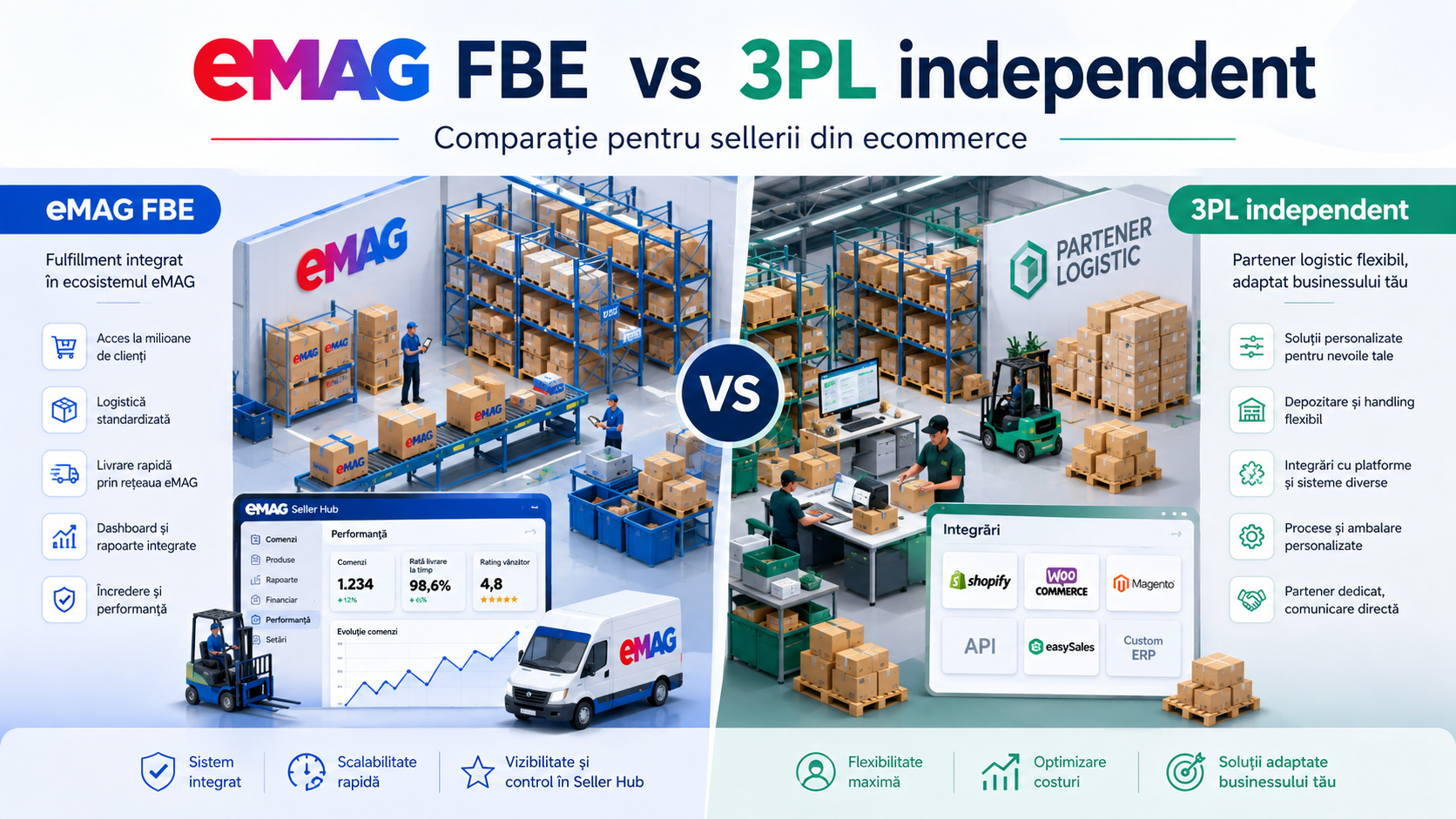
eMAG Marketplace lets you fulfill orders either through Fulfillment by eMAG (FBE) or through your own or external fulfillment (a 3PL). The cost per order is similar. The real difference is strategic: FBE stock sells only on eMAG, while a 3PL fulfills all your channels from a single stock — eMAG, Shopify, your own website, TikTok Shop, Trendyol, Temu.
It is one of the most frequent questions sellers ask as they grow on eMAG: "Do I have to put my goods in eMAG's warehouse, or can I work with someone else?". You read the short answer above. But the right decision comes down to one thing most guides ignore: how many channels you sell on, or want to sell on. Let's break it all down, with numbers.
The starting point
What Fulfillment by eMAG (FBE) actually is
Fulfillment by eMAG (FBE) is eMAG's integrated logistics service: you send your products to eMAG's warehouse and they handle storage, order processing, packaging, courier handover, customer care and returns. It is a pay-as-you-go program, with no subscription and no minimum inventory. According to eMAG, through FBE you get access to over 240,000 m² of storage space — the largest warehouse in South-Eastern Europe.
The genuine advantages of FBE, which it is only fair to acknowledge:
- The "Delivered by eMAG" badge — your products gain extra visibility and buyer trust. According to data shared by eMAG, the "Delivered by eMAG" filter generated up to 50% additional sales, and FBE offers reach the customer in 1.5 days on average.
- Fast delivery in 3 countries — a single stock at eMAG delivers in Romania, Bulgaria and Hungary.
- Customer care and returns handled by eMAG — you don't deal with "where is my parcel?".
- First 30 days of storage free for each replenishment.
In short: if you sell exclusively on eMAG and have fast-moving products, FBE is a solid service. The problem appears the moment your business no longer fits into a single channel.
The alternative
What an independent 3PL is (and how it connects to eMAG)
A 3PL (third-party logistics) is an independent fulfillment center that stores your stock, processes your orders and hands parcels to the courier — exactly like FBE, but without being tied to a single marketplace. A modern 3PL such as Fast Fulfill connects natively to eMAG Marketplace through API integration: eMAG orders flow automatically into the system, are processed and shipped, and stock syncs in real time.
The essential difference, and the reason it's worth reading on: the same physical stock in a 3PL fulfills all your sales channels simultaneously. If you want to understand in detail how a fulfillment center works, we wrote a separate complete guide.
FBE is a per-channel fulfillment solution (eMAG only). A 3PL is a per-business fulfillment solution (all channels). This architectural difference matters more than any per-order price difference.
Why a 3PL
7 concrete advantages of an independent fulfillment center
Beyond the cost per order — where, as you'll see below, the two are nearly equal — a 3PL such as Fast Fulfill gives you a set of strategic advantages that a program tied to a single marketplace simply can't offer. Here are the ones that matter most for a store that wants to grow:
Sell on every channel from a single stock
eMAG, Trendyol, Temu, your own Shopify or WooCommerce store, MerchantPro, TikTok Shop — all fed from the same warehouse. You no longer keep separate goods for each platform and you stop losing sales because "the stock was in the wrong place".
Expand to new channels with no logistics investment
Want to launch on Trendyol or your own website alongside eMAG? With a 3PL you simply add a new integration — the stock already exists. You don't ship goods to another warehouse, negotiate another contract or lock up more capital. You grow horizontally, not into a closed silo.
Real control and full visibility over your goods
Through the 24/7 client portal you see stock, orders in progress, receipts, returns and invoices in real time — for all channels in one place. Your goods don't vanish into a "black box"; you know exactly what you have, where, and how much.
Independence from any single marketplace
You don't tie your entire logistics to the rules, commissions or algorithm of one platform. If eMAG changes its policies or you want to diversify your risk, you have full freedom to shift focus to another channel — without relocating your stock.
Public pricing, no surprises
A full 8-tier grid published on the website, no monthly minimum, no setup fee, no minimum volume. You pay exactly what you use and know from day one what it costs — storage is fixed at 0.40 €/m³/day, predictable no matter how long goods stay.
Custom packaging and branding
Unlike a marketplace's standardized fulfillment, a 3PL can pack orders in your boxes, with your inserts, labels and unboxing experience. The end customer receives your brand, not the platform's.
48h onboarding, native integration
From signing to the first shipped order in 48 hours. Native API integration with eMAG and 13 other platforms — orders flow in automatically, stock syncs in real time, with no manual work.
Head-to-head comparison
FBE vs independent 3PL — on every dimension
Whether you use FBE or a 3PL, the eMAG sales commission (between 7% and 25% depending on category, applied to the price excluding VAT + shipping) is paid the same way. The commission is not a deciding factor between the two options — it applies in both cases when you sell on eMAG.
The honest math
On cost per order, FBE and 3PL are nearly equal
Let's be fair: if you look strictly at the processing cost of an eMAG order, the two options are remarkably close. Here is the calculation for a small product (fits in a bubble mailer), at a medium volume of 1,500 orders/month (the T6 tier in the Fast Fulfill grid):
In other words: nobody is "ripping you off" on the cost per order. If you sell exclusively on eMAG and have fast turnover, FBE is competitive and also gives you the "Delivered by eMAG" badge. The smart decision is not made on the price per pick — it's made on your stock architecture. And that's where everything changes.
The argument that matters
What happens when you sell on multiple channels
Picture a store doing 1,500 orders/month: 900 come from eMAG (60%) and 600 from other channels — an own Shopify website, TikTok Shop and a WooCommerce store (40%). This is where the two models diverge sharply.
The FBE scenario: fragmented stock, double capital
With FBE, the stock in eMAG's warehouse can fulfill only the 900 eMAG orders. For the other 600 orders from other channels you need a second stock, held elsewhere — at home, in your own warehouse, or at another 3PL. The concrete consequences:
- Capital locked in two places — you have to buy and tie up goods separately for each logistics "pocket".
- Cross-channel stockout risk — you run out of stock on eMAG while you have plenty for Shopify (and vice versa), with no way to shift quickly between them.
- Double reconciliation — two inventory systems, two stock counts, two invoices, double monthly admin effort.
- FBE storage on slow movers — products that don't sell within 30 days start accumulating storage fees.
The 3PL scenario: a single stock, all channels
With a 3PL such as Fast Fulfill, all 1,500 orders are fulfilled from a single stock. eMAG orders flow in through the native integration, exactly like those from Shopify or TikTok Shop. One inventory, one invoice, zero fragmentation. If a product sells better on TikTok one month and worse on eMAG, the stock is shared — you don't lose sales because "the goods were in the wrong warehouse".
On fulfillment cost per order, the two are equal. But FBE forces you to fragment stock across channels, while the 3PL consolidates everything. For a multi-channel store, capital efficiency and single-stock flexibility are worth far more than any few-cents difference per pick.
Decision framework
When to choose FBE and when to choose a 3PL
- eMAG is your only sales channel and you don't plan others soon
- You have fast-moving products that sell within 30 days (avoiding storage fees)
- You want the "Delivered by eMAG" badge for maximum visibility and conversion on the platform
- You sell cross-border in BG/HU and want fast delivery from eMAG's warehouse
- You want eMAG to handle customer care and returns
- You have your own website (Shopify/WooCommerce) + eMAG + possibly TikTok Shop, Trendyol, Temu
- You want a single stock feeding all channels, with no fragmentation
- You have a wide catalog or slower-moving products (predictable fixed storage)
- You don't want to depend on the rules and algorithm of a single marketplace
- You want transparent public pricing, with no minimum fee and no setup fee
The third way
The hybrid approach — you can use both
It's not an all-or-nothing choice. Many mature sellers use a hybrid strategy: "star" products with very fast turnover stay in FBE to benefit from the "Delivered by eMAG" badge and maximum visibility on the platform, while the rest of the catalog — slow-moving SKUs, products for other channels, backup stock — stays at a 3PL that feeds all channels.
The downside of the hybrid approach is complexity: you manage two systems, two stocks and two invoices. For most stores under 50 SKUs, consolidating on a single 3PL is simpler and more efficient. If you want to understand exactly how much an order costs you in each scenario, we built an interactive calculator that shows your concrete numbers.
The conclusion
The answer to the original question
Yes — you can sell on eMAG Marketplace without using FBE, through an independent fulfillment center that integrates natively with eMAG. On cost per order, the two are comparable. The smart decision depends on how many channels you have:
- If eMAG is your only channel and you have fast turnover → FBE is a very good option.
- If you sell on multiple channels (or want to grow beyond eMAG) → a 3PL gives you a single stock for everything, total flexibility and independence from any single marketplace.
For a store that wants to grow long-term without tying its entire logistics to the algorithm and rules of a single platform, the independent 3PL is almost always the smarter strategic choice — because it preserves your freedom to sell anywhere, from a single stock, with full control over your goods and your brand. You sell on eMAG today, add Trendyol and your own website tomorrow, without moving a single pallet. That's the difference between a solution that serves you now and one that supports you as you grow.
Want to sell on eMAG and every other channel from a single stock?
Calculate your exact quote for your volume and products in our public calculator, or write to us directly for an analysis of your specific case — no obligations, no personal data.
Frequently asked questions
FAQ — eMAG FBE vs independent 3PL
Can I sell on eMAG Marketplace without using Fulfillment by eMAG (FBE)?
Yes. eMAG lets you fulfill orders either through FBE (eMAG stores and ships) or through your own or external fulfillment. An independent 3PL such as Fast Fulfill integrates natively with eMAG, receives orders automatically and processes them — with the advantage that the same stock also fulfills your other channels (Shopify, WooCommerce, own website, TikTok Shop, Trendyol, Temu).
What is the main difference between eMAG FBE and an independent 3PL?
FBE stock fulfills only eMAG orders (RO, BG, HU). A 3PL fulfills all channels from a single stock. On cost per order the two are comparable (FBE processing from 3.40 RON/unit vs ~3.40 RON pick & pack at a 3PL at medium volumes), but the 3PL eliminates stock fragmentation and dependence on a single marketplace.
How much does Fulfillment by eMAG (FBE) cost?
FBE is pay-as-you-go, with no subscription and no minimum inventory. Costs: order processing (from 3.40 RON/unit, depending on size/weight) + storage (free for 30 days/replenishment, then a volume-based fee). Separately you pay the eMAG sales commission (7%-25% depending on category), which applies regardless of the fulfillment method. For an exact estimate, use eMAG's official FBE simulator.
Why would a seller choose a 3PL instead of FBE?
The main reason is multi-channel selling. If you also sell on platforms beyond eMAG, with FBE you need separate stock for each — capital locked in multiple places, cross-channel stockout risk, double reconciliation. A 3PL fulfills all channels from a single stock, with native eMAG integration, transparent public pricing, and without locking you into the rules of a single marketplace. For wide catalogs or slow-moving products, it also has a storage advantage (a fixed rate vs FBE fees after 30 days).
Can I use FBE and a 3PL at the same time?
Yes — the hybrid approach. Fast-moving products that benefit from "Delivered by eMAG" stay in FBE, while the rest of the catalog stays at a 3PL that feeds all channels. The downside is complexity: two systems, two stocks, two invoices. For stores under 50 SKUs, consolidating on a single 3PL is usually simpler and more efficient.
Do I lose the "Delivered by eMAG" badge if I use a 3PL?
Yes, the "Delivered by eMAG" badge is specific to stock physically held in FBE. If you fulfill eMAG orders through a 3PL, you still sell on eMAG (with courier delivery), but without that badge. For products where "Delivered by eMAG" visibility is decisive, the hybrid approach (those SKUs in FBE, the rest at a 3PL) may be the optimal solution.
Sources and references used
- eMAG Marketplace — Fulfilment by eMAG (FBE) — official service description, processing from 3.40 RON/unit, 30 days free storage, access to 240,000 m²
- eMAG Marketplace — Taxes and commissions — 7%-25% commission by category, applied to the price excluding VAT + shipping, no monthly or listing fee
- eMAG Marketplace — FBE cost simulator — the official tool for estimating processing and storage costs
- eMAG Group (2025 report) — data on FBE growth (+54%), the "Delivered by eMAG" filter (+50% sales), 1.5-day average delivery, the "Deschide România" program
- Startarium (2025) — guide on commissions, rating and visibility on eMAG Marketplace for sellers
- Fast Fulfill public pricing grid — 8 price tiers (T1-T8), Pick & Pack from €0.42/order, storage at 0.40 €/m³/day
FBE figures are indicative and depend on the size, weight and turnover of your products. For exact values, consult eMAG's official FBE simulator. Exchange rate used for conversions: 1 € ≈ 5 RON.