

Returns management in eCommerce: the process, the real costs and how a 3PL handles them
Returns are the part of logistics nobody plans for — but everybody pays for. Here’s what a correct reverse logistics flow looks like, what every step costs, and what you can do to get fewer returns and recover more stock.
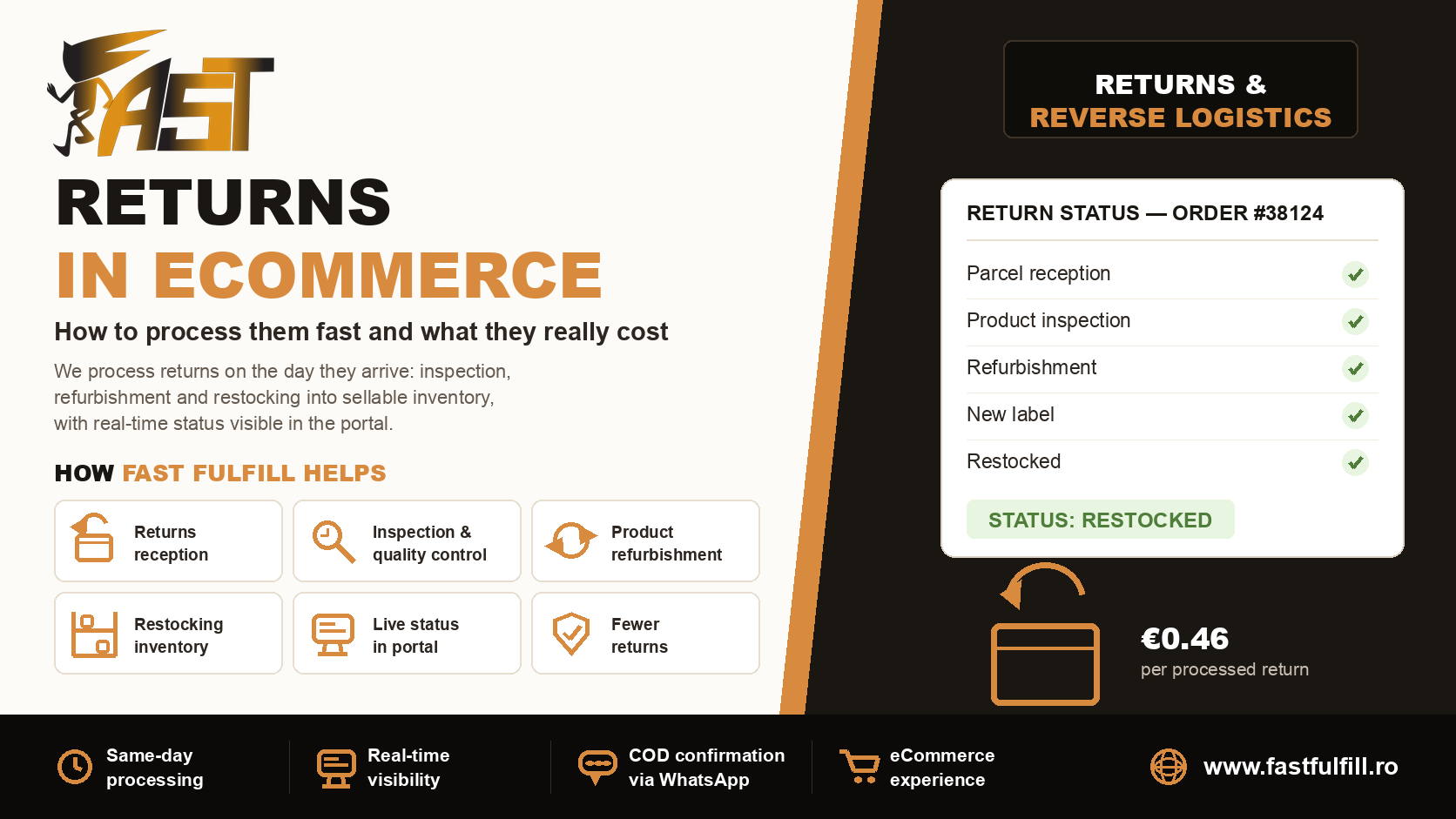
A return costs 2-3 times more than it seems: round-trip shipping, warehouse processing, refurbishment and immobilized inventory. The good news: with a correct reverse logistics flow, most products go back into sellable stock the same day. At Fast Fulfill, processing a return costs from €0.46 per return — a fixed, transparent rate, among the lowest on the market.
When you build your business case, it’s easy to only look at the outbound journey: order, packing, delivery, payment. But eCommerce also has a return journey — and in categories like fashion, return rates can exceed 20-30% of orders. Add the delivery refusals typical of cash-on-delivery (COD) orders in Romania, and you get a cost very few entrepreneurs measure precisely. This guide breaks it down step by step: what physically happens to a return, what each stage costs and — most importantly — how to reduce the volume of returns before they happen.
The context
Why returns are the hidden problem of Romanian eCommerce
In Romania, returns come from two distinct sources, and the difference between them matters enormously for your costs:
- Classic returns — the customer receives the product, unpacks it and sends it back: wrong size, doesn’t look like the photos, changed their mind. Under Romanian law (OUG 34/2014), customers have a legal right to return products within 14 days, no justification needed.
- Delivery refusals (COD-specific) — the customer simply doesn’t pick up the parcel or refuses it at the door. The parcel comes back sealed, but you’ve paid for shipping both ways without collecting anything.
A COD refusal is “cheaper” to process (the parcel comes back sealed, the product stays sellable), but it’s a 100% loss on shipping with zero chance of revenue. A classic return at least had a sale behind it — and part of them can be prevented with better product content. The reduction strategies are different for each, so measure them separately.
The flow
What physically happens to a return in the warehouse
In a well-organized fulfillment center, a return isn’t a box thrown in a corner — it’s a standardized flow, logged in the WMS at every step:
Reception
The returned parcel is received, scanned and matched to the original order. The return becomes visible in the portal from this moment.
Inspection
The product is checked: sealed or unsealed, complete, damaged, labels intact. The return reason is recorded.
Refurbishment
If needed: repackaging, new label, folding and resealing. The product is brought back to selling standard.
Restocking
Sellable products go back on the shelf and into available stock. Non-sellable items are separated, with a documented reason.
The key to the whole process is restocking speed: every day a returned product sits unprocessed is a day of capital locked in a box instead of stock that sells. In short-season categories (fashion, gifts), a return processed in 3 weeks can completely miss its selling window. The right standard: returns are processed on the day of reception or the next day.
The costs
What a return really costs you — the full breakdown
Let’s break down the real cost for both scenarios, for a product sold at 150 RON:
At a 15% return rate and 1,000 orders per month, you have 150 returns to process: at Fast Fulfill that’s 150 × €0.46 = ~€69 per month for all the processing. The rest of the real cost is round-trip shipping — under your courier contract — plus immobilized stock and lost margin. To see where these numbers fit in your total cost per order, use our guide to calculating the real cost per order.
Warehouse processing is the small part of the cost: just €0.46 per return at Fast Fulfill. The big part is shipping and lost margin. That’s why the best anti-return investment isn’t “cheaper processing” — it’s fewer returns. That’s the next section.
Prevention
How to reduce your return rate before the return exists
Accurate descriptions and photos
The most frequent return reason: “it doesn’t look like the photos”. Real photos, exact dimensions, correctly described materials — the cheapest anti-return measure there is.
Detailed size guide
Essential in fashion and footwear. A size table with measurements in centimeters visibly reduces “it doesn’t fit” returns.
WhatsApp confirmation for COD orders
The most profitable measure for the Romanian market: COD orders are confirmed before shipping, and delivery refusals drop dramatically. See how it works.
Quality control before dispatch (QC)
The wrong or defective product that never leaves the warehouse is a return that never happens. Checking at packing prevents the most frustrating returns.
Proper packaging
A product damaged in transit is a guaranteed return plus a lost customer. Packaging matched to the product (not just the cheapest option) pays for itself.
Measure return reasons
If you don’t know why products come back, you can’t fix anything. Every return logged with a reason = data you turn into assortment and content decisions.
Capabilities
How Fast Fulfill handles returns
Available reverse logistics services
- Returns reception with order matching
- Inspection and reason logging
- Refurbishment: repackaging, relabeling
- Same-day restocking into sellable inventory
- Non-sellable stock separation with documented reason
- Real-time status in the client portal
- WhatsApp COD confirmation (prevention)
- QC before dispatch for error-free orders
- Returns reports by reason and product
- Flexible decisions: restock, disposal or return to you
Every return is visible in the portal from the moment of reception: you see what came back, why, what condition the product is in and whether it went back into sellable stock. If you want to understand the full operational flow inside the warehouse, read our guide on how a fulfillment center works.
Want to know what your returns cost you right now?
Tell us your monthly order volume, return rate and product category — we’ll run a concrete simulation: what you’re losing now and what you’d save with a correct reverse logistics flow.
Frequently asked questions
FAQ — returns and reverse logistics
How much does return processing cost in fulfillment?
At Fast Fulfill, processing a return costs from €0.46 per return and includes reception, checking and restocking into sellable inventory. Complex refurbishment (special repackaging, new labels) is quoted separately, depending on complexity. Courier return shipping is added on top, under your contract.
What is the average return rate in eCommerce in Romania?
It varies by category: fashion and footwear can exceed 20-30%, electronics and personal care usually stay below 10%. For COD orders, delivery refusals add another 5-15% of parcels without an order confirmation process. Exact figures depend on your niche, return policy and content quality.
What happens to a returned product in a fulfillment center?
Four steps: parcel reception and order matching; product inspection (sealed, complete, damaged); refurbishment if needed (repackaging, relabeling); restocking into sellable inventory or separation as non-sellable, with a documented reason. Everything logged in the WMS, with status visible in the portal.
How can I reduce my online store’s return rate?
Accurate descriptions and photos; a detailed size guide (essential in fashion); WhatsApp confirmation of COD orders before shipping; quality control before dispatch (QC); and proper packaging. Together, these measures visibly reduce both classic returns and COD refusals.
Are COD delivery refusals processed the same way as returns?
Yes, but a refused parcel usually comes back sealed: inspection is quick and the product almost always goes straight back into sellable stock. The main cost is round-trip shipping, paid with zero revenue. That’s why confirming COD orders before shipping is the most profitable anti-return measure.
Can I track returns in real time?
Yes. Every return is logged in the WMS at reception, with status in the client portal: received, under inspection, restocked or separated as non-sellable, with the reason. You have full visibility over recovered stock and decide quickly what happens with non-sellable products.